Professionnal Training – Where are our former students?

Between 2014 and 2019, our Pastry school has seen 5 intakes of students and 80 young women have graduated from our professional training programme. What have they become? Let’s take a look at their different paths and their current situation in a Cambodia which is booming, but where there are still many disparities..


The Survey

The Bayon social team carried out a survey early 2020 on 80 alumni with the following aims:

  1. Analysing the impact of the pastry/baking training in the employability of the young women
  2. Noting their personal satisfaction in their current job
  3. Understanding the level of income that they earn in order to live a decent life.

Out of 80 alumni, 65 took part in the survey (by telephone or via an online form), which represents 81% of our former students.


Here are some key figures:

  1. 86% of the students questioned are currently in employment with 14% not working (unemployed, maternity leave or further studies at university). Three quarters of them work in Siem Reap.
  2. The average wage for our former students, across the five different intakes, is $190 per month.
  3. None of those surveyed plans to change jobs and 9 out of 10 are fully satisfied with the skills acquired during the training programme in Bayon Pastry School. They have also confirmed that these skills are extremely useful on a day-to-day basis.

82% of the former students surveyed are currently working in the hotel & restaurant sector and so are using the skills they acquired in Bayon daily.


A reasonable wage in Cambodia.

Although Cambodia introduced a legal minimum wage of $170 (for the textile sector) in January 2018, a large majority of the population does not earn that amount. The students who graduate from the Bayon Pastry School are generally recruited at an average wage of $163 for the first year. This wage increases quite quickly and they can earn up to 15% more in their second year.
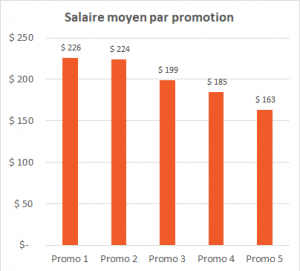
The average wage of the graduates surveyed is 190 $/month (excluding those who are not currently working). We can see a clear link between the years of experience and the salaries which increase by 40% over 5 years. When asked “Can you live comfortably and without extra help on your salary?”, 3% (2 graduates) confirmed that they were living comfortably and 89% thought that they were just scraping by.


Meeting their own needs and supporting their families.

The data above illustrates how precarious the situation is for the families of our graduates: many have debts to pay back and as soon as a member of the family can meet his/her own needs with a regular wage, he/her must support the family. Of the 65 alumni questioned, 61 indicated that they were sending money back to their family each month. The amounts for 75% of them varied from $50 to 150$ per month; in other words, up to half of their wage.

KOLA – Former student, training a new student at her new job.


The Role of Bayon School.

Our role is to train young women for a practical profession which will allow them to access the workplace quickly, where they can earn a decent, sustainable wage. For most of them, a large chunk of this salary will be sent to their family, which gives our young graduates the impression that they are just scraping by. However, we do need to remind them that our training programme is relatively new, but that the salaries do increase over the years with experience: +40% over 5 years. Most importantly, we need to remind them that it is the whole family which is better off; brothers and sisters who can go to school, grandparents who can get medical treatment and women who can be proud of having brought about this change.
 

PARTNERSHIP WITH PSE

PARTNERSHIP WITH PSE

PARTNERSHIP WITH PSE ASSOCIATION

As presented and voted at the AGM in Paris, June 2019, the partnership project between Bayon School and PSE is now underway.

WHY THIS PARTNERSHIP ?

Since its beginning 20 years ago, the Bayon School has made tremendous progress, recruiting many talented people, achieving well-deserved success & continually launching new initiatives. It is still hugely rewarding to participate actively in the education of so many underprivileged children from Siem Reap, from signing them up for their primary school years and following them through their secondary years, to developing the Pastry School & Coffee Shop and now by providing the necessary know-how to help families participate in the Green Project.
However, at the same time, we have made some observations;
With the primary school located within the temples, we are no longer able to expand. This forces us to make very difficult decisions when selecting new pupils as we cannot satisfy all the requests, of which there are far too many. Furthermore, our primary school pupils from twenty years ago are now grown-up; we have supported them throughout their studies, but many of them are now looking for jobs. Finally, whilst our “small is beautiful” set-up allows us to be creative, flexible and reactive as well as “entrepreneurial”, it also suffers from the fragility of a small structure.
With all this in mind, we set out on a search for a partner, who would allow us to keep our values, our DNA, our “footwork”, but who would also open doors to new initiatives and professional opportunities for the children, giving the Bayon School long term security, from both an organisational and a societal point of view.

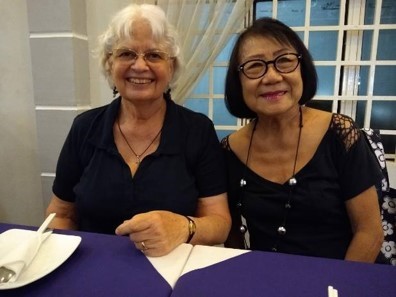
Deux femmes posent pour une photo

PSE “Pour un Sourire d’Enfant”, (For a Child’s Smile) an association set up in 1996 by Christian and Marie-France des Pallières, quickly emerged as the ideal association for this partnership.
PSE is a charity registered in Cambodia where it currently takes care of over 6500 children and their families through financial support. PSE also has a number of vocational schools where students can learn a skilled trade in hospitality, management or sales & technical.

PSE has developed its activities mainly in Phnom Penh with some branches outside the capital, but the association has also been overwhelmed by its success and is now facing some challenges with its local branches.

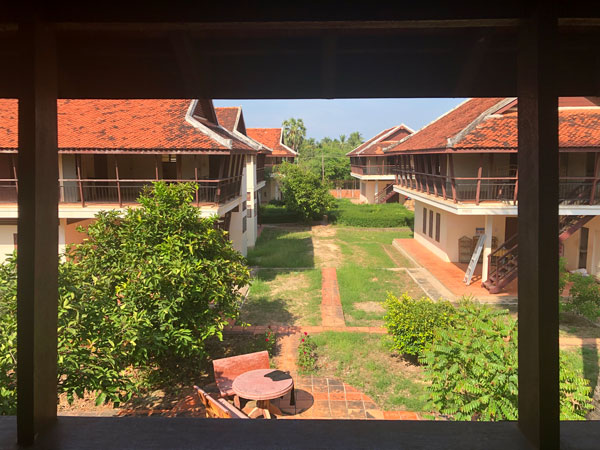
Deux maisons et un jardin

In the Siem Reap branch, where there are around 10 full-time employees (social team and operational support), PSE currently helps 414 children who are enrolled in local state schools and accompanies 200 families with financial support. It also has a “reception centre” with various buildings on a large plot of land close to the town centre, but this is not currently being optimised, Under the terms of our agreement, the Bayon School will take on the management of these activities in Siem Reap through synergies of both associative models and the local teams.

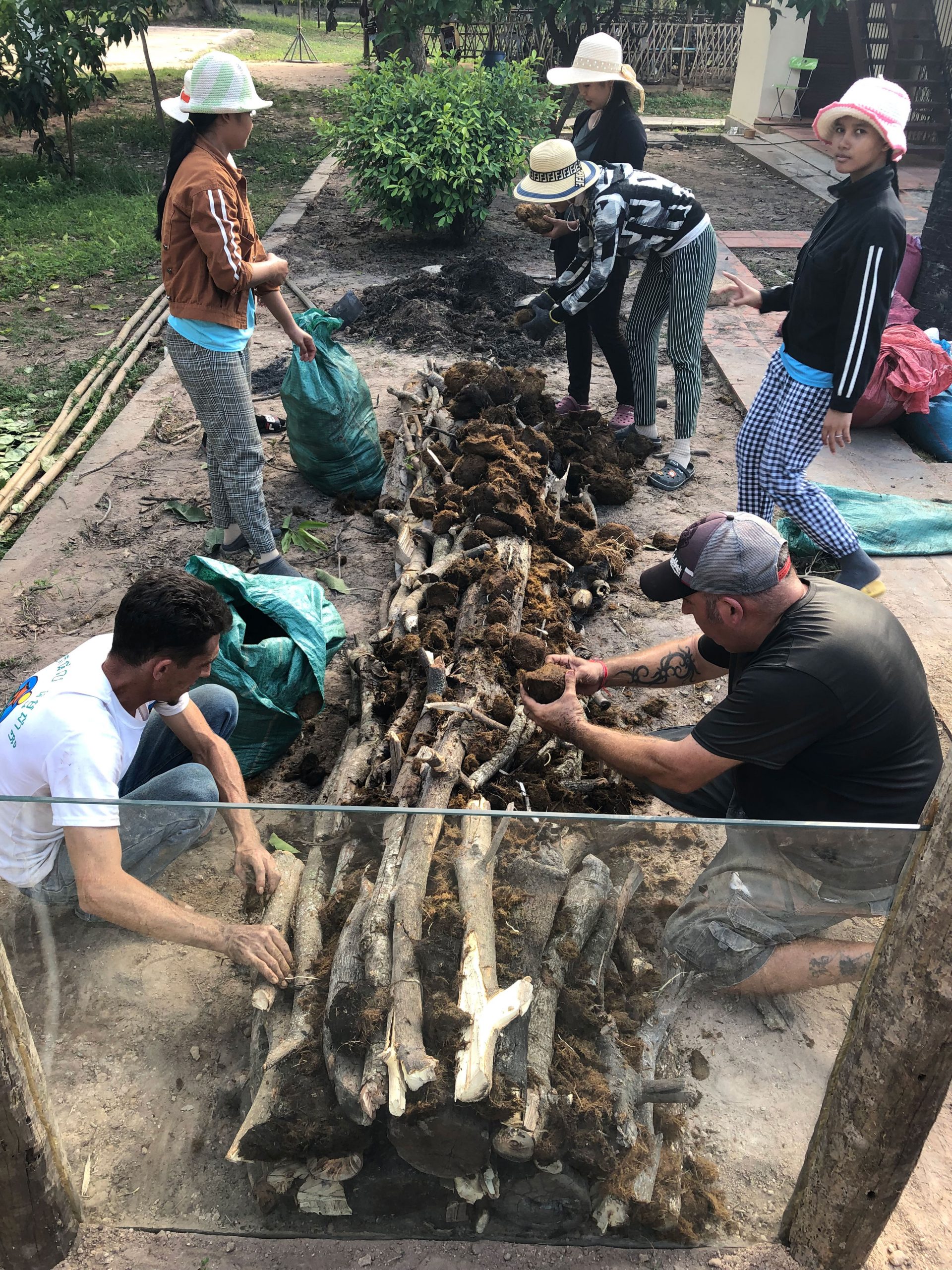
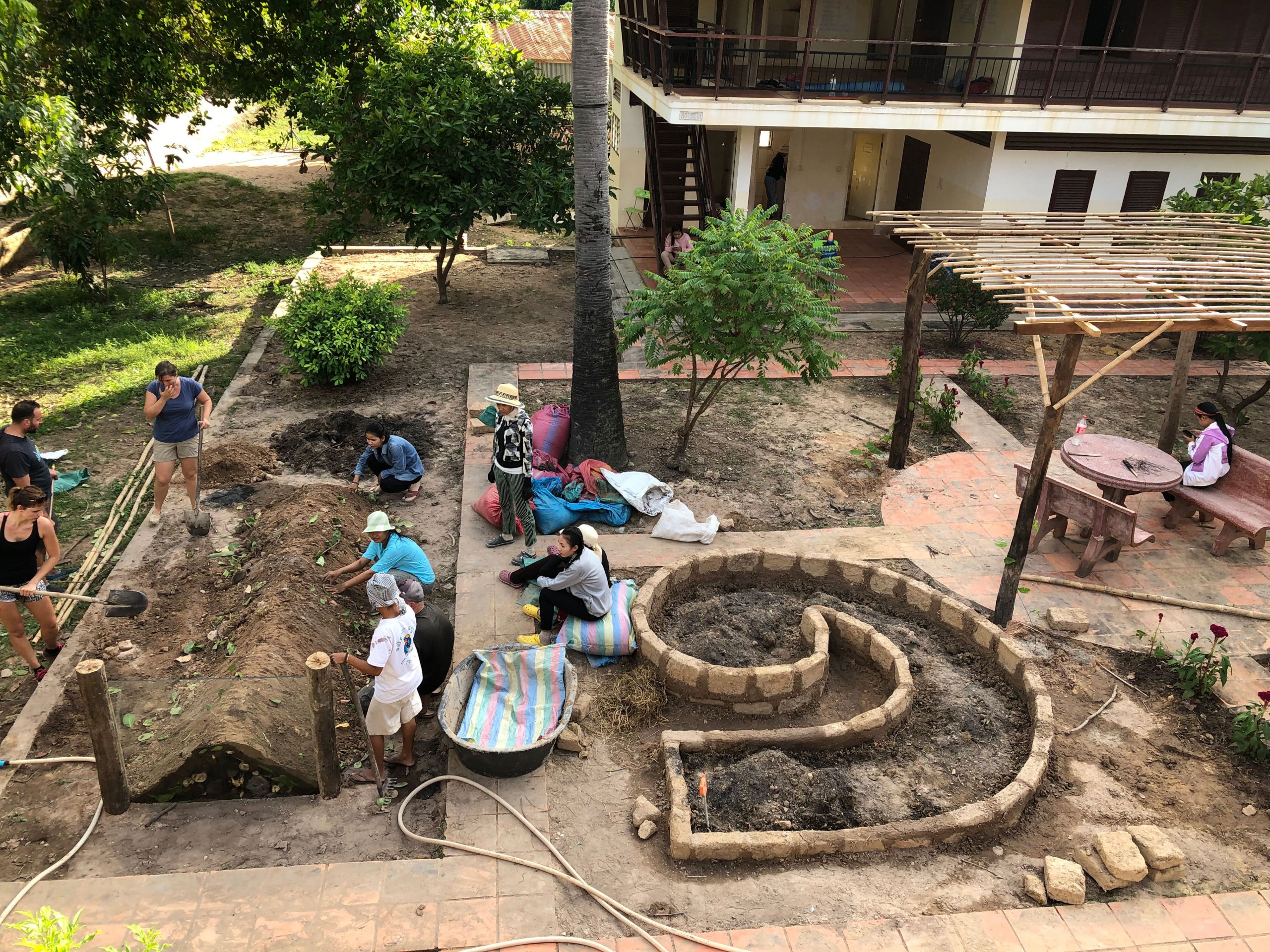
Right now, the first project on this plot will be the setting up of an experimental farm of permaculture – or “integrated agriculture” – which will be the basis of a future vocational training programme. More news and photos of this project in the next newsletter!

Des gens travaillent dans un jardin

Des travaux pour aménager un jardin potager


New work space at pastry school

New work space at pastry school

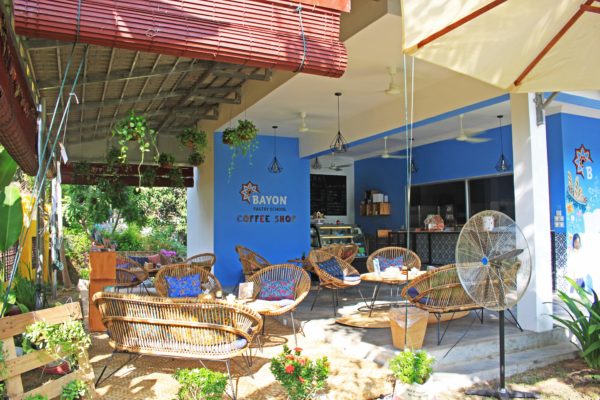
The Bayon Pastry School has begun its sixth school year with a new intake of 26 students. The site has been transformed from its modest beginnings and the training programme is now highly professional and well known in and around Siem Reap.

Our experience has led to a growing reputation and our students find jobs easily once they have finished the programme. Over the last 5 years, 86 students have graduated and found stable jobs.

What’s next? We want to grow and improve our training site as well as the quality of our bread. Our students are trained mainly in pastry but we want to develop our bread-making programme. With this in mind, we have decided to create a new baking laboratory for use by our students.
WEB-IMG_0987

Let’s find out more from Sokhoeurn, the head of the Pastry school:

What are the objectives of this new work space?
The main objective is to extend our premises to allow us to recruit more than 25 students per intake. In addition, up until now, we have concentrated on pastry and the equipment we use is not particularly adapted to bread-making. We would therefore like to invest in more specialised equipment for this new programme.

What has changed compared to the old pastry lab?
Apart from giving us more space, the major improvement has been made in reaching required standards of hygiene. With this new work space, we will be able to operate in compliance with international standards of hygiene and food safety.
WEB-IMG-1805
Have you invested in specific equipment?
We have invested in the small equipment which Is essential for break-making, as well as a dough-making machine, spiral mixers and an oven. I am particularly proud of the investment in the cold storage room which will enable us to manage our stock better. These recommendations were made by Lesaffre and Arizta, our partners on this project.

What are your projects for the future?
We would like to improve the quality of our bread and then promote it in Siem Reap. We want our students to realise how important bread is; they need to understand that it is the equivalent of the rice that we eat with every meal in Cambodia!

A very big thank you to all our sponsors, this project could not exist without your loyal support : Aryzta, Fondation Sodebo, Lesaffre, Kitchen Aid ; and not forgetting severals donators who gave in honor of Irene Meister.
WEB-IMG_20191209_164149

“SBEK THOM”, KHMER SHADOW THEATRE

“SBEK THOM”, KHMER SHADOW THEATRE

Sbek Thom is Khmer shadow theatre featuring two-metre high, non-articulated puppets made of chiselled leather. Dating from before the Angkorian period, Sbek Thom, along with the Royal Ballet and mask theatre, is considered sacred. Dedicated to the divinities, performances could only take place on specific occasions three or four times a year, such as the Khmer New Year, the King’s birthday or the veneration of famous people. After the fall of Angkor in the fifteenth century, shadow theatre evolved beyond a ritualistic activity to become an artistic form, while retaining its ceremonial dimension. Since 2008, it has been inscribed by UNESCO on the list of Masterpieces of Oral and Intangible Heritage of Humanity.
(source : unesdoc.unesco.org).
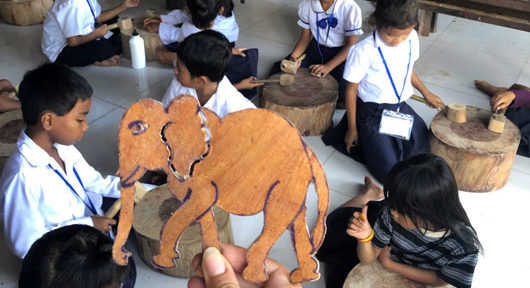
At the Bayon School, we believe it essential to carry on with this tradition and including it in our programme of extra-curricular activities is an integral part of this process. After developing our lessons of sport, arts & crafts and Apsara dance, the introduction of lessons of Khmer puppetry allows us to link history, creativity & teamwork.
WEB-IMG_1464
Before all else, we would like to introduce Tob Leang, our new puppet teacher at the Bayon School. Tob Leang studied the history and creation of puppets for three years at the Bambu Stage, a social entreprise based in Siem Reap, which aims to highlight young talent through crafts and traditional Khmer culture. He joins the Bayon team today in the hope of passing on his knowledge to the pupils at our primary school.
Our project is ambitious as we want to put on our first Khmer shadow theatre presentation at the Bayon School at the end of the first semester. There are of course numerous steps to integrate beforehand:
WEB-IMG_1451
• First learning step: hold and learn to use the tools required to make the puppets as chiselling the leather is a complex technique to master. All our pupils will learn to select the tool, which is best adapted to obtain the desired shape of the puppet.
• Once this step has been mastered, it is time to make the actual puppets. Using a small chisel and a hammer, the children learn step-by-step how to trace straight lines, before moving on to making their first samples. Taking into account the dexterity required by the pupils, the team at Bayon have decided to start the puppet-making lessons in Grade 2 (7-8 years old)
WEB-IMG_0092
• Once the little puppets have been made, there remains one essential step, and not the easiest! Memorising g the scenario and learning how to bring the puppets to life to ensure a successful presentation.
Tob Leang spent a long time working on this scenario before arriving at Bayon; it requires a great deal of attention and concentration from the children, as you can see from the photos!
WEB-IMG_1512
At the time of writing this article, the children have made tremendous progress and most of the puppets have already been made. For news on the presentation at the end of the semester, you will have to wait until the next newsletter at the end of March!A very big thank you to Fondation Insolite Bâtisseur – Philippe Romero, which finance this project and enable them to set up this new complementary class.

Another school year comes to an end at the Bayon School…

Another school year comes to an end at the Bayon School… and before we know it, another group of students has joined the pastry school whilst nineteen new little ones fill the empty benches in the Kindergarten class. Such is the life of a school: some move on, leaving the space open for others to integrate our classes. There is always a lot happening, which is how it should be! Initiatives come to light, ideas abound, things take shape, the teams get on board and new projects come to life…

Maternelle-groupe
The 2018/2019 school year started at the primary school with an overhaul of the teaching system, following recommendations made by Rodrigo and Anaïs, after their audit of our pedagogical set-up.• A new primary head has been recruited and the teaching team has been renewed, giving preference to full-time contracts, which allows us to put in place extra support classes for children who may be struggling.
• Two new buildings have opened their doors; a computer classroom for the pupils of Grades 5 & 6, as well as a library with over 400 books in Khmer.
• A brand-new canteen and water management system have been inaugurated.

These investments have only been made possible through the generous support of our sponsors and donators. Without them, we would not be able to achieve so much. An enormous THANK YOU!

Anais-et-Rodrigo
Our secondary students participated in the monthly careers events with professionals who came to present their jobs. A jewelry designer, HR in a travel agency, accountant in an NGO, manager of a hotel: very diverse worlds come together to talk to our students, allowing them to project themselves into a professional future which is not really that far away after all. This year, they were also lucky to be able to participate in an intercultural exchange with students from the Lycée Français of Singapore, which was rich in emotion.
The vegetable gardens have never produced as much as this year; it really was a bumper crop! 80% of the canteen’s vegetables were grown locally and ecologically in the plots of the 8 families involved in the Green Project. Every day at daybreak, 25 Kg of vegetables arrive by motorbike, tuktuk or even bicycle to allow our cooks to prepare the meals for our 250 pupils, who start lunch at 11 o’clock for the youngest amongst them. It is quite a marathon to keep the families motivated as market gardening really is a daily enterprise with no time for rest. This year, we have been able to equip each family with an automatic irrigation system, allowing them time for other activities such as weeding, harvesting, pest control, etc.

Sem-Chum-potager
At the pastry school, 21 young women graduated at the end of August. With their diploma under their arm, they set off towards a secure professional future in the hotels in Siem Reap or Phnom Penh and/or in the bakeries looking for qualified labour. These students, who joined us in September 2018, were unrecognisable when they left; shy, reserved and unsure of themselves at the beginning, they left us brimming with self-confidence and armed with a trade that they can and must promote. We are astounded by their capacity to learn and absorb so much in only 12 months.

Intake-5-graduated
The new students who arrived in August 2019 have already taken their first steps in the pristine Bakery Lab, which we have just inaugurated and which will enable us to train more students in better conditions.

The Bayon School is moving forward – thanks to its teams and numerous loyal donators who believe in its project. Let’s continue together!

Please find attached the Activity Report for the year 2018/2019 for further details on what we do.

Secret Link